What people mean by task paralysis
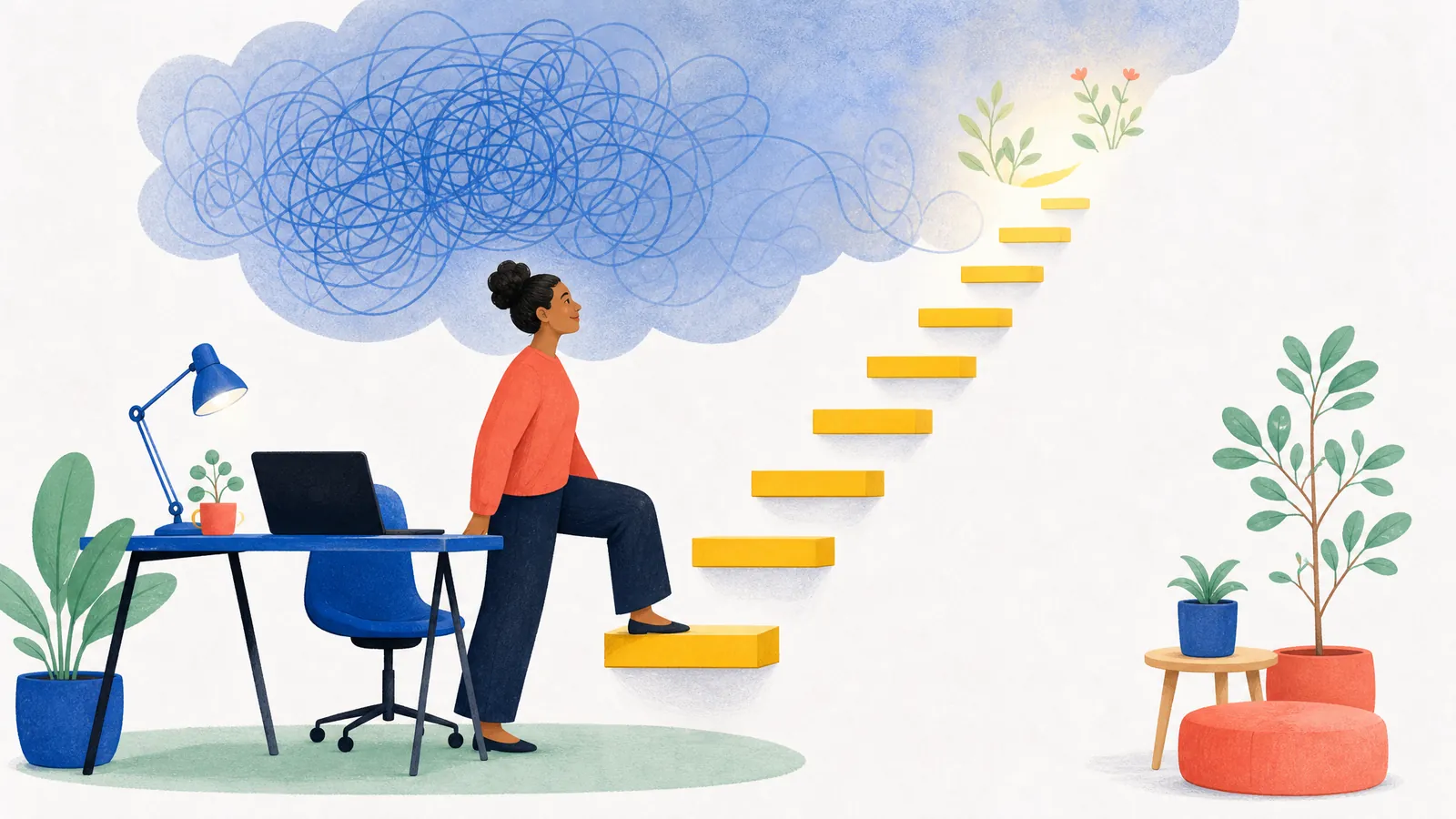
You know what you need to do. You might even want to do it. But you can't start. You sit there, or scroll, or tidy something else, while the task gets heavier the longer you leave it. A lot of people with ADHD call this task paralysis.
It isn't a medical term, and you won't find it in diagnostic manuals. But it sits close to things the NHS does list for adults with ADHD, such as "finding it hard to organise your time" and "finding it hard to follow instructions or finish tasks".
It isn't laziness. Laziness is not wanting to do something. Task paralysis is wanting to, and still not being able to start. That difference matters, because what helps is making the start easier, not telling yourself to try harder.
Why starting can be so hard
Researchers don't have a single answer, but a few explanations have reasonable support.
Executive function
Executive functions are the brain's management skills: planning, holding things in mind, switching between tasks and getting going. NHS England's guidance describes ADHD as "best understood as a syndrome with deficits across multiple domains of executive function". A 2005 review of 83 studies found that people with ADHD scored lower on executive function tasks on average, by a moderate amount. The same review found these difficulties are "neither necessary nor sufficient": not everyone with ADHD has them.
Motivation and reward
A brain imaging study of 45 adults with ADHD linked lower motivation scores to differences in the brain's dopamine reward pathway. It's one small study, and it shows a link rather than a cause. But it fits what many people describe: tasks with no quick pay-off are much harder to start.
Procrastination
A 2026 systematic review of 11 studies, covering 2,788 people, found ADHD traits were consistently linked with procrastination, with inattention showing the strongest link. Most of the studies were snapshots in time, so they can't show that one causes the other.
Research describes groups, not you. Not everyone with ADHD gets stuck in the same way, and getting stuck doesn't mean you have ADHD.
Is it ADHD, anxiety or low mood?
It can be hard to tell, and it can be more than one thing. The NHS notes that people with ADHD often have other conditions too, such as depression or anxiety. Freezing in front of a task can also come from fear of getting it wrong, or from feeling low and flat.
If getting stuck comes with low mood most days, losing interest in things you used to enjoy, or feeling hopeless, talk to your GP. If you're struggling to cope right now, you can call Samaritans free on 116 123, day or night.
Ways through, step by step
None of these is a cure, and none will work every time. They're practical ways to make starting smaller and easier. Try one at a time.
- Shrink the first stepMake it so small it feels almost silly: open the document, put the form on the table, write one sentence. Starting is the hard part, so make the start tiny.
- Use an if-then planTie the first step to a cue: "If it's 9am and I've made a coffee, then I'll open my inbox and answer one email." Plans like this have good evidence in the general population. Research in ADHD is small, and mostly in children.
- Set a short timer with a fixed breakWork in short blocks with breaks decided in advance, such as 24 minutes on and 6 off. In one study of university students without ADHD, fixed breaks led to less tiredness, and the same amount of work in less time, compared with taking breaks whenever they felt like it.
- Remove one obstacleLook for the friction: the laptop that needs charging, the login you can't remember, the pen you can never find. Fix that one thing, and starting gets easier next time.
- Work alongside someoneSome people find it easier to start with another person nearby, in the room or on a video call. This is often called body doubling. We couldn't find any controlled trials of it yet, but it's free and low-risk to try.
- Decide by rule, not by feelingIf choosing what to do first is what freezes you, use a simple rule, such as the nearest deadline or the smallest task. Then follow the rule, not the mood.
An if-then plan you can copy
"If it's [time or cue], then I'll [tiny first step] for [number] minutes."
What has the best evidence
Here's an honest summary of the research, from the most studied to the least:
| Approach | What the research shows |
|---|---|
| CBT (a talking therapy) for adults with ADHD | A 2026 review of 70 studies found moderate improvements in day-to-day functioning, strongest at work, though its authors flag risk of bias. A 2018 Cochrane review rated the evidence as low quality. In a US trial of 86 adults already taking medication, more people improved with CBT than with relaxation training. |
| If-then plans | A review of 94 tests in the general population found a medium to large effect on following through. Studies in ADHD are few, small and mostly in children. |
| Fixed breaks | One study of 87 university students without ADHD found less tiredness and similar output in less time. |
| Breaking tasks down and removing friction | Widely recommended, but not tested in ADHD-specific trials. NICE does stress the importance of changes to your environment. |
| Body doubling | No controlled trials that we could find. Some people find it helps. |
If you have an ADHD diagnosis and need support beyond, or instead of, medication, NICE says adults should be offered at least a structured psychological intervention focused on ADHD, with regular follow-up, which may include CBT. Ask your GP or ADHD service what's available near you.
When it keeps happening
Everyone gets stuck sometimes. If it's happening most days, and it's costing you at work, with money or in your relationships, it's worth talking to your GP. If you think ADHD might be part of it, our guides on preparing for an adult ADHD assessment and ADHD Right to Choose explain the next steps.
Questions people ask
Is task paralysis real?
It isn't a diagnosis or a medical term. But difficulty organising and finishing tasks is a recognised feature of ADHD, and research consistently links ADHD traits with procrastination.
Is task paralysis only an ADHD thing?
No one has shown that. Anxiety and low mood can also make starting hard, and they often happen alongside ADHD. If your mood has been low for a while, talk to your GP.
Is task paralysis the same as procrastination?
There's no agreed clinical difference. Research usually calls it procrastination, and in ADHD, inattention shows the strongest link. Many people use "task paralysis" for the specific feeling of wanting to start and not being able to.
Which strategies have the best evidence?
Structured CBT for adults with ADHD has the most research, though its quality is mixed. If-then plans and fixed breaks have support in the general population. Body doubling hasn't been tested in controlled trials.
What can I do when I'm frozen right now?
Pick the smallest possible first step, set a timer for five minutes, and only do that. Some people also find it helps to stand up, change room, or tell someone what they're about to do.
Sources
- NHS. ADHD in adults. Reviewed 19 March 2025.
- NHS England. 2026/27 NHS Payment Scheme: ADHD and autism payment guidance. March 2026.
- Willcutt and others, Biological Psychiatry. Validity of the executive function theory of attention-deficit/hyperactivity disorder: a meta-analytic review. 2005.
- Volkow and others, Molecular Psychiatry. Motivation deficit in ADHD is associated with dysfunction of the dopamine reward pathway. 2011.
- Suriano, Research in Developmental Disabilities. A systematic review on the association between ADHD and procrastination. August 2026.
- López-Pinar and others, Behaviour Research and Therapy. Cognitive behavioral therapy effects on global functioning, domain-specific functioning, and quality of life in adult ADHD: a comprehensive meta-analysis. June 2026.
- Lopez and others, Cochrane Database of Systematic Reviews. Cognitive-behavioural interventions for attention deficit hyperactivity disorder (ADHD) in adults. 2018.
- Safren and others, JAMA. Cognitive behavioral therapy vs relaxation with educational support for medication-treated adults with ADHD and persistent symptoms: a randomized controlled trial. 2010.
- Gollwitzer and Sheeran, Advances in Experimental Social Psychology. Implementation intentions and goal achievement: a meta-analysis of effects and processes. 2006.
- Guderjahn and others, ADHD Attention Deficit and Hyperactivity Disorders. Self-regulation strategies support children with ADHD to overcome symptom-related behavior in the classroom. 2013.
- Biwer and others, British Journal of Educational Psychology. Understanding effort regulation: comparing 'Pomodoro' breaks and self-regulated breaks. 2023.
- NICE. Attention deficit hyperactivity disorder: diagnosis and management (NG87), recommendations. 2018, updated 2019.
This article is general information, not medical advice, and it doesn't diagnose ADHD. Talk to your GP about your own situation. In crisis? Call Samaritans on 116 123.